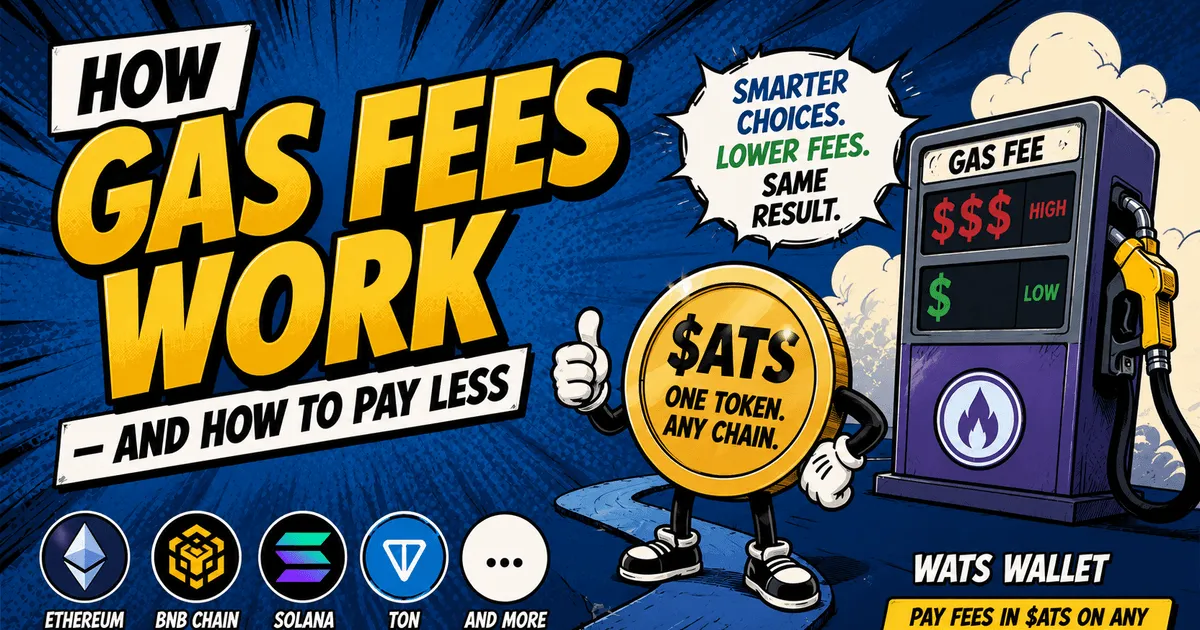
Every action on a blockchain — sending tokens, swapping, minting — asks the network to do work and permanently record the result. Gas is the fee that pays for that work. Without it, there would be no incentive to process transactions or keep the network secure.
What sets the price of gas?
Two things: how much computation your transaction needs, and how busy the network is. Simple transfers are cheap; complex smart-contract calls cost more. On top of that, gas is a live market — when many people transact at once, they bid the price up to be included sooner. That is why fees spike during popular mints or market volatility.
Why you sometimes need several tokens
Gas is normally paid in the network’s native token — ETH on Ethereum, BNB on BNB Chain, SOL on Solana, TON on TON. Use several chains and you have to keep a little of each just to move funds. It is one of the most common friction points for newcomers.
How can you pay less gas?
- 1Time it. Fees are lower when the network is quiet — often outside peak US/EU hours.
- 2Pick the right chain. Low-fee networks and layer-2s can cost a fraction of mainnet for the same action.
- 3Batch and simplify. Fewer, well-formed transactions beat many small ones.
- 4Use single-token gas. Some wallets let you pay fees in one token across networks, so you don’t hold every native coin.
WATS Wallet lets you pay transaction fees in Alltoscan Token ($ATS) on any supported network — so there’s no need to hold each chain’s native token just to transact.
Explore WATS WalletFurther reading